

Beyond the Annual Meeting:
Designing a Holistic Career hub for 12,000 international Vision Scientists
International medical research association, 12,000+ annual meeting attendees and 11,000 members. Led end-to-end strategy—from a 400-user study to final deployment—unifying 3 distinct websites into a single design system for international audiences
Shifting the membership value proposition from a "single annual event destination" to a "holistic, year-round career and networking resource"
The association faced a drastic 50% membership churn among young professionals (Members-in-Training). Members were using the organization transactionally—canceling their memberships if they didn't have funding to attend the Annual Meeting or research to present, because they failed to see the year-round value of the organization. ARVO is often five years ahead of the industry in sharing medical breakthroughs. Retaining these young researchers is critical to accelerating global collaboration and advancing vision-saving medical science.
A deeply global audience (40% of members are international/ESL) requiring simple, jargon-free navigation. The internal landscape involved managing three siloed digital properties (Main site, Foundation, Annual Meeting) managed by the same internal team.
A global medical audience: Surveyed 400 members and interviewed 7 professionals ranging from Members-in-Training (MITs) to Retired Members across the US, UK, Australia, India, and Japan. Tree tested 86 participants, deliberately accounting for a 27% ESL (English as a Second Language) base.
Synthesis approach: Segmented research data by career stage (MIT vs. Regular Member) to isolate exact drop-off points in the user journey. Utilized line charts to visualize tree testing paths and identify where users became lost in the architecture.
Key Findings: Uncovered a massive "imposter syndrome" problem—members weren't avoiding committee applications because of the UI, but because the criteria felt too intimidating. Also proved via tree testing that users strongly associate "Funding Guides" with "Awards and Grants," not "Professional Development," shifting the entire site architecture.
Engineered a specialized tree testing methodology to specifically evaluate cognitive load and jargon comprehension for an international, highly scientific ESL audience.
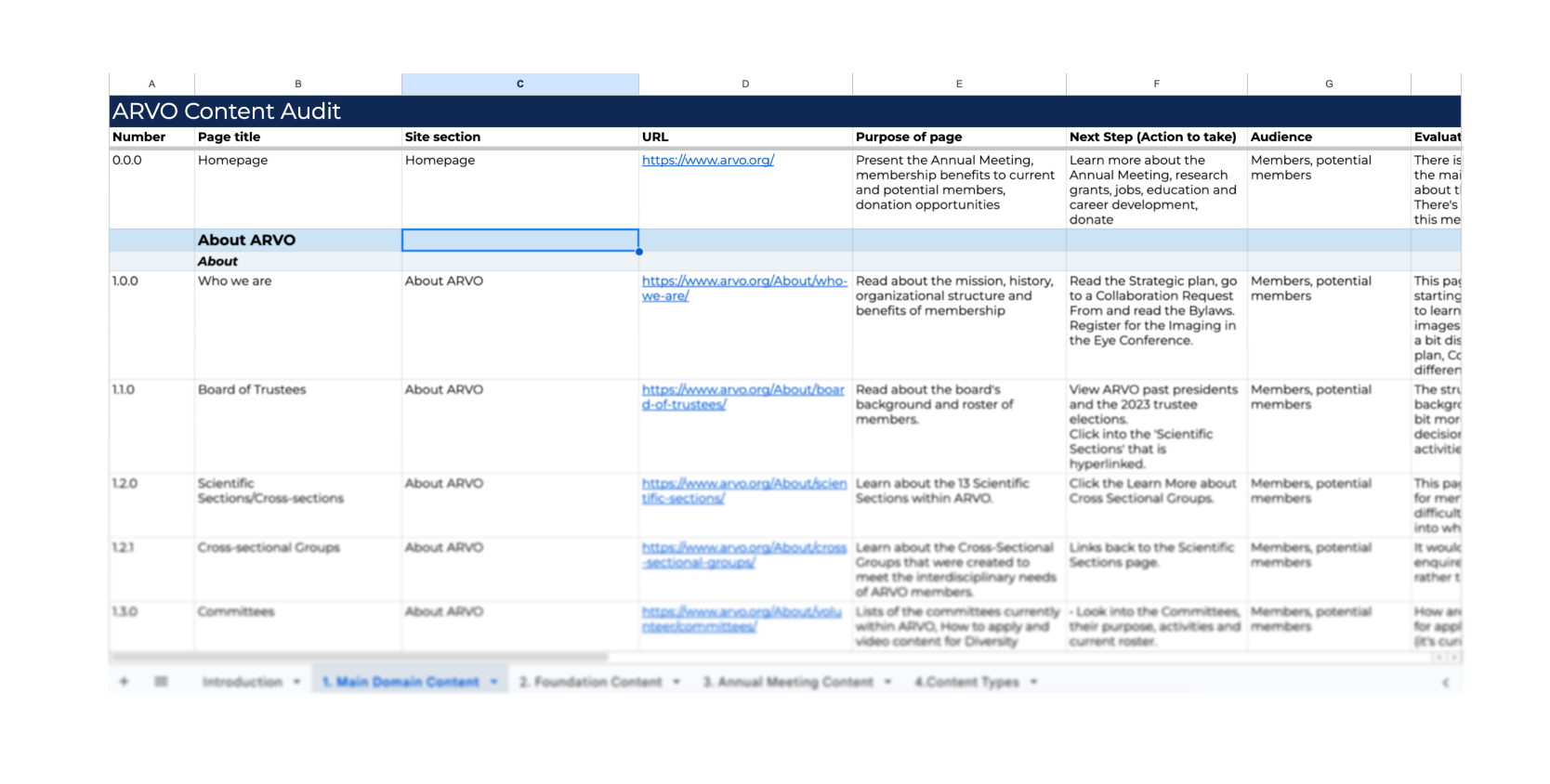
Content Audit
I completely overhauled the planned IA based on surprising data. I moved "Webinars" out of the "Education" section and into "Meetings and Events" because testing proved 40% of users conceptually associated webinars with calendar events. I also moved the "Funding Guide" into "Awards and Grants" after it completely failed in the "Professional Development" section (only an 11% success rate). Driven strictly by my Tree Testing data (86 participants, 13 tasks). I grouped all volunteer activities under a unified "Get Involved" CTA after testing showed a 93% success rate for that path.

New Sitemap
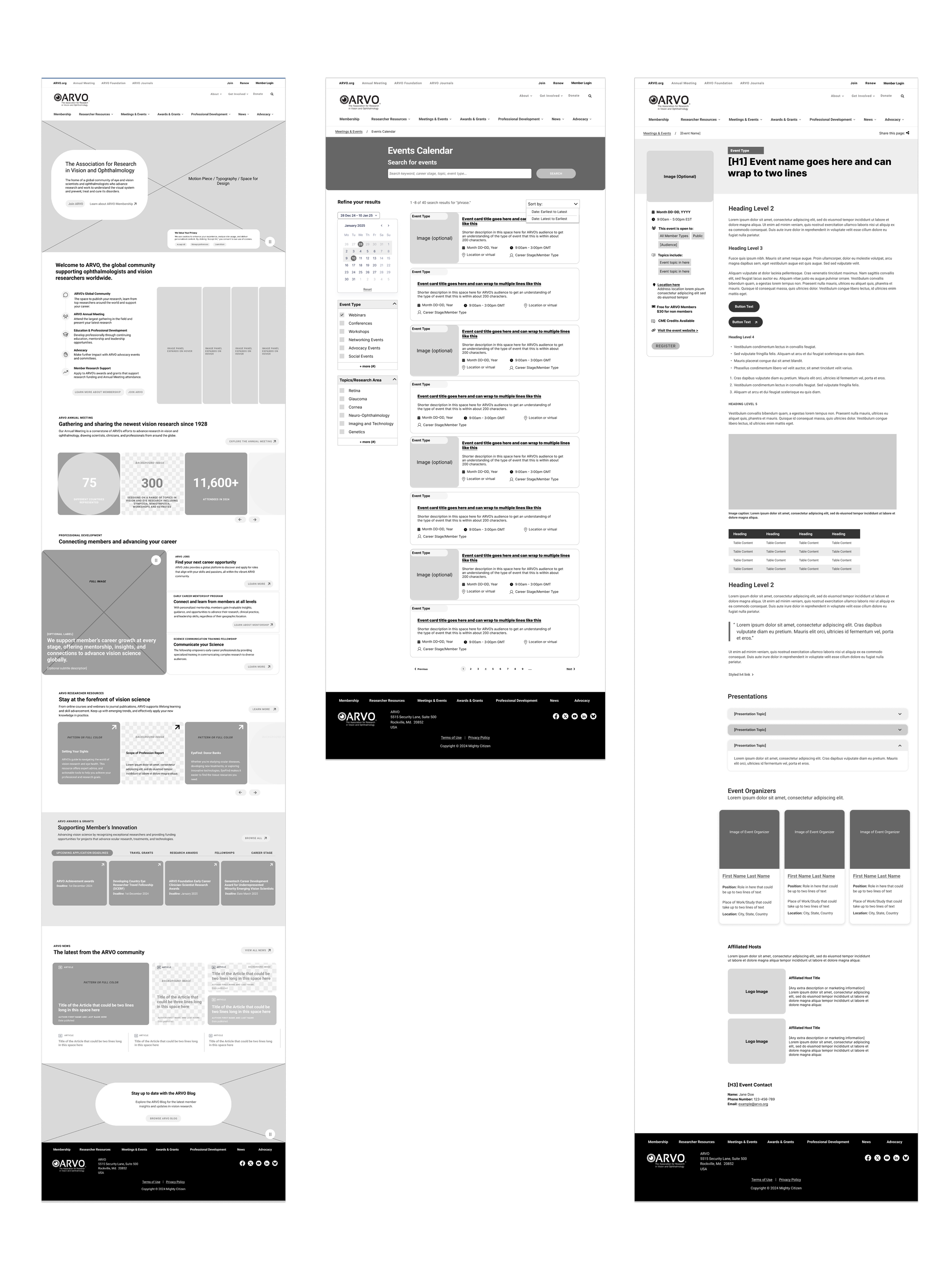
Homepage, Event Calendar and Event Detail wireframes
Experience-based creation: Engineered a massive multi-site consolidation, unifying the main arvo.org, the ARVO Foundation, and the Annual Meeting site into a single, cohesive digital system.
Accessibility decisions: Designed for a 40% international, 27% ESL audience. Pushed back on the client's use of image-based buttons, explicitly recommending accessible HTML buttons to support screen readers.
Managed the UX transition from discovery to a 1,399-hour development phase, coordinating closely with the Director of UX, multiple front-end developers, and marketing strategists.
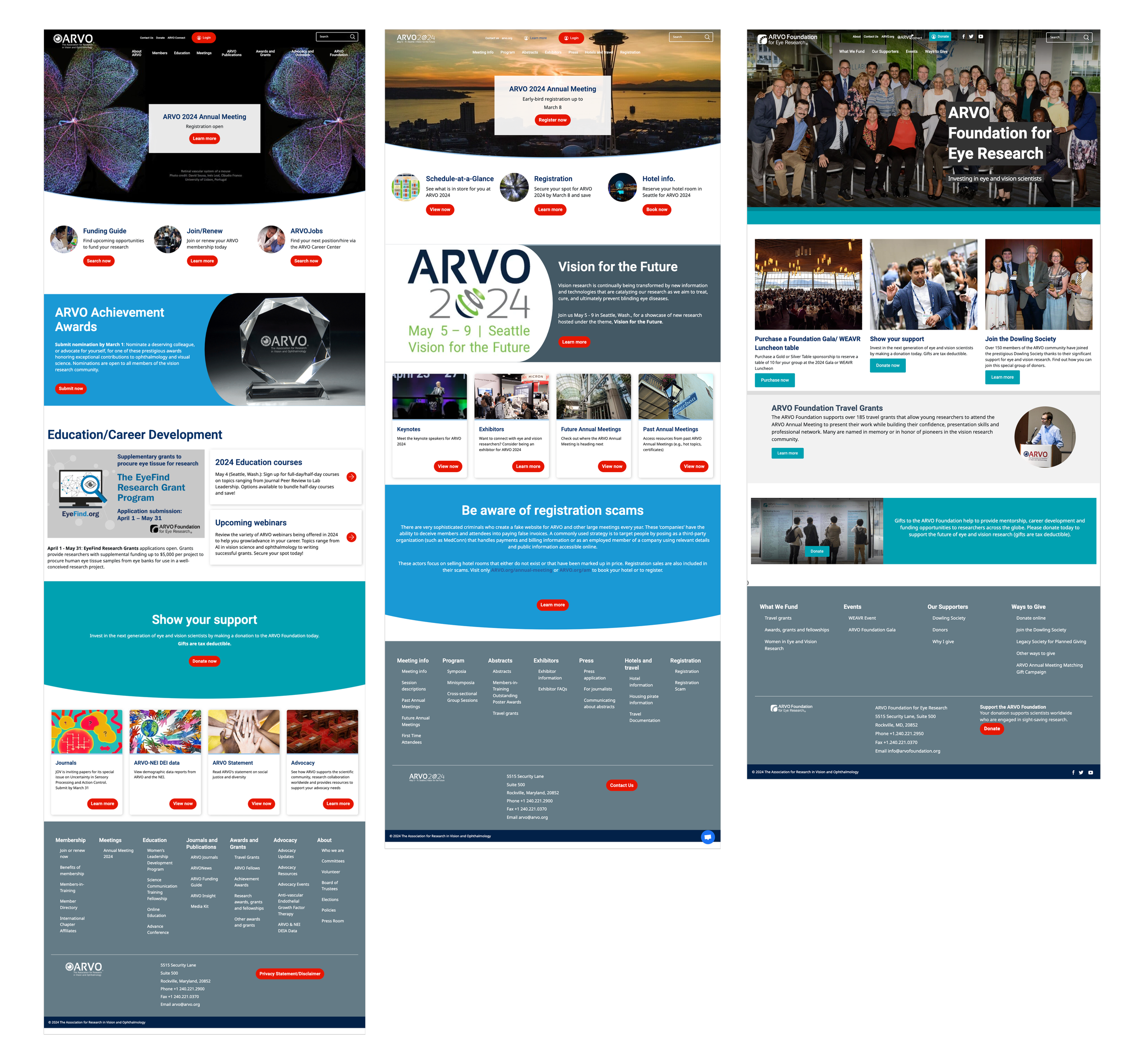
Homepages Before

Homepages Visual Designs after
I mentored and directed a support UX Designer during the massive 1,399-hour implementation phase, ensuring strict adherence to the UX strategy we established in discovery.
I made several unilateral architectural pivots based on data that contradicted client assumptions. I moved "Webinars" into "Meetings and Events" (because 40% of users viewed them as calendar events) and moved "Funding Guide" to "Awards and Grants" after it completely failed in the "Professional Development" section with only an 11% success rate.
- What would not have happened without me — The total re-architecture of ARVO’s digital presence from an "Annual Meeting-centric" model to a "holistic year-round career" model. I uncovered that early-career members were churning because they couldn't see the value outside the event.
- Original framework or model I developed — I engineered a highly specialized Tree Testing Methodology designed specifically to test cognitive load and scientific jargon comprehension for an audience that is 40% international and 27% ESL (English as a Second Language). I also built segmented Value Matrices mapping exact differences in needs between Members-in-Training (MIT) and Regular Members.
- I made several unilateral architectural pivots based on data that contradicted client assumptions. I moved "Webinars" into "Meetings and Events" (because 40% of users viewed them as calendar events) and moved "Funding Guide" to "Awards and Grants" after it completely failed in the "Professional Development" section with only an 11% success rate.
- Domain expertise applied — Scientific publishing UX, medical association membership models, and complex multi-site domain consolidation.
- Downstream reach — Rearchitected the digital hub for a global medical association serving vision researchers and ophthalmologists, directly impacting the experience of 12,000+ Annual Meeting attendees. Designed specifically for a highly global user base, accommodating a 40% international and 27% ESL (English as a Second Language) audience.
- Business outcome — Directly tackled a severe 50% membership turnover rate among early-career individuals (MITs) by redesigning the site to highlight year-round career value. Executed the massive 1,400-hour implementation phase.
- Accessibility — Removed inaccessible components to ensure strict ADA compliance for screen readers
"We are so impressed with the effort the MC team has put into collecting information to fully understand who ARVO is, who we represent, and how this website will benefit the industry we support. I have never worked with a company that cares enough to take this deep of a dive. It is truly refreshing and confirmed for us that we went with the right partner."
Led multiple high-level stakeholder presentations, including delivering the "Research Findings & Strategic Brief" deck and the "Tree Testing Insights & Sitemap" presentation to ARVO leadership.
I would restructure the internal QA and client review phases. On this project, we carried two distinct wireframe batches all the way through testing, which duplicated client handoffs and drove up project hours. In the future, I would execute batched internal QA but consolidate the client-facing QA into a single, unified review. I would also communicate earlier in the sales/scoping process that extensive tree testing requires directly contacting the client's member base to avoid client surprises.
What this changed in my practice
I experimented with a new content integration template early in the wireframing phase. While it presented challenges, it allowed us to uncover content gaps much sooner, profoundly changing my practice to integrate content collection directly into the early wireframe batches rather than waiting for design approval.
Thank you for looking through my work!
More projects are right here >>